

Chemical Metering Pump Diagram
Diaphragm metering pumps are relatively simple in design. Madden pumps generally consist of four main sections: the wetted end, the drive system, the motor, and the output adjustment. Madden builds pumps with rugged materials that stand the test of time. When a part wears out after years of use, the simple yet affective, design of our pumps makes for easy maintenance. Both of these factors contribute to our overall goal of building high-quality pumps that will meter chemicals accurately with little-to-no downtime. Our pumps are designed to meter chemicals within +/- 1% of your desired flow rate.
The diagram below shows the four basic sections of our JN and MF Series pumps. We will take a more in-depth look at these sections below.

Wetted End
The wetted end refers to the section of the pump that comes in contact with the liquid that will be pumped. This section consists of several parts: the solution head, the diaphragm, the inlet and outlet check valves and the piping connectors. All of these components need to be compatible with and resistant to the chemical that will be pumped. Madden and other metering pump manufacturers like LMI, Milton-Roy and Pulsafeeder offer a wide range of materials for the wetted end construction to allow the pump specifier to select the right materials for each pumping application. Piston or plunger type metering pumps do not use a diaphragm to separate the liquid in the wetted end from the drive mechanism. Those pumps use a packing gland for the purpose of containing the liquid.
Drive System
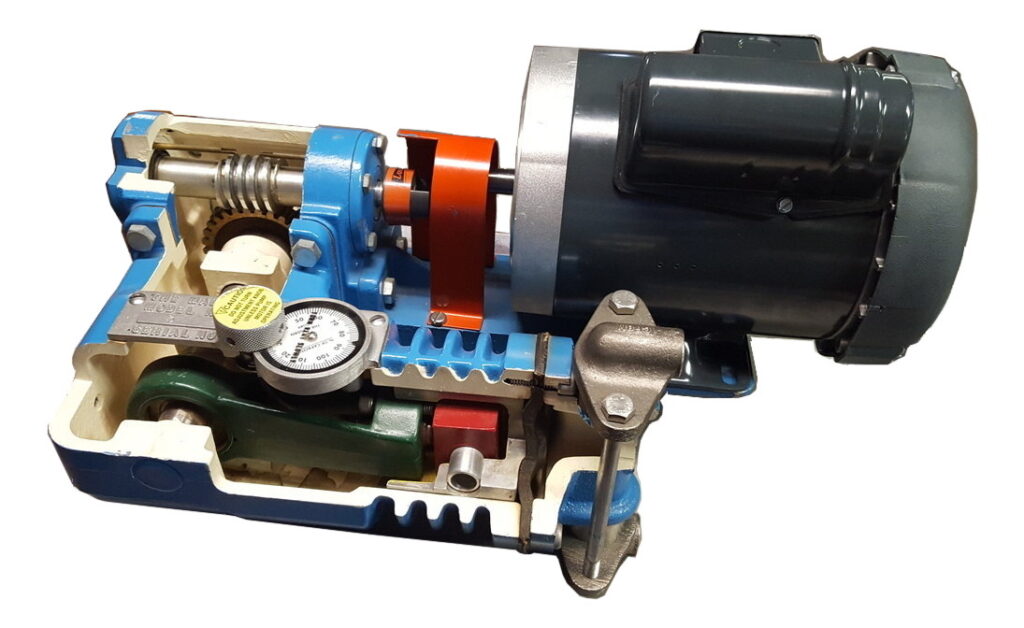
The drive system section takes the rotary power of an electric motor and converts it into a piston stroking action. Madden and many other metering pump manufacturers use a right-angle worm gear reducer to convert the 1725 rpm electric motor speed to a stroking speed ranging from 15 to 230 strokes per minute in different pump models. The gear ratio used in the worm gear reducer will determine the stroke speed; i.e. a 10:1 gear ratio will reduce the 1725 rpm motor speed to 172 strokes per minute drive shaft speed. The connecting rod and piston are driven by the drive shaft. As the drive shaft rotates, the connecting rod and the attached piston, will make a stroke in and out, driving the diaphragm in the wetted end which moves the liquid being pumped. Madden uses heavy duty industrial grade worm gear reducers to insure many years of trouble-free pumping service. Madden pumps have a mechanically actuated diaphragm, so the piston is directly connected to the diaphragm in the wetted end. Other manufactures use a hydraulic system to push and pull the diaphragm. Some manufactures of smaller metering pumps do away with a gear reducer altogether and use an electric solenoid stroking mechanism to activate the metering pump piston. Take a look at the cutaway pump shown below to get a visual understanding of how Madden drive systems work.
Motor
Most Madden diaphragm metering pumps use an electric motor for the power to operate the pump. Stock motors for Madden are from 1/3 HP to 1-1/2 HP, 56 frame, totally enclosed, with both 1/60/115-230 and 3/60/230-460 voltages available. Special motors are available for a wide range of applications from 50 Hz power to explosion proof and high-altitude installations.
Output adjustment
Madden diaphragm metering pumps are manually adjustable using a conveniently placed adjustment knob located on top of the pump. The adjustment goes from 100% down to 0%. For the most accurate volume control 10% is the minimum recommended adjustment setting. The output adjustment on Madden pumps is a loss of motion type adjustment. This means that for any adjustment setting below 100, the diaphragm is not powered by the piston over a portion of the rotation of the drive shaft. Some manufactures use a hydraulic drive and reduce the stroke volume in the hydraulic section with a loss of motion action. There are pumps on the market that offer an adjustable eccentric for controlling the output, and some of these require the use of tools to change the eccentric setting when the pump is stopped. Electronic solenoid type metering pumps can manually reduce the stroke rate with an adjustment knob, or they can actuate the solenoid with a remote pulse signal. For information on Madden metering pumps using an automatic output control see the blog Drive Motor Specifying Automatic Metering Pump. The important thing to know is that the pump you specify will have the capacity in the range of adjustment to accurately pump the required liquid volume, and that the adjustment of volume is easy to accomplish.
For more information on our pumps, take a look at the Madden Pump Selection Guide. If you have an questions, give us a call, or send us a message through our website. We are always quick to respond.